
Subtotal ₹0.00 Subtotal: ₹0.00



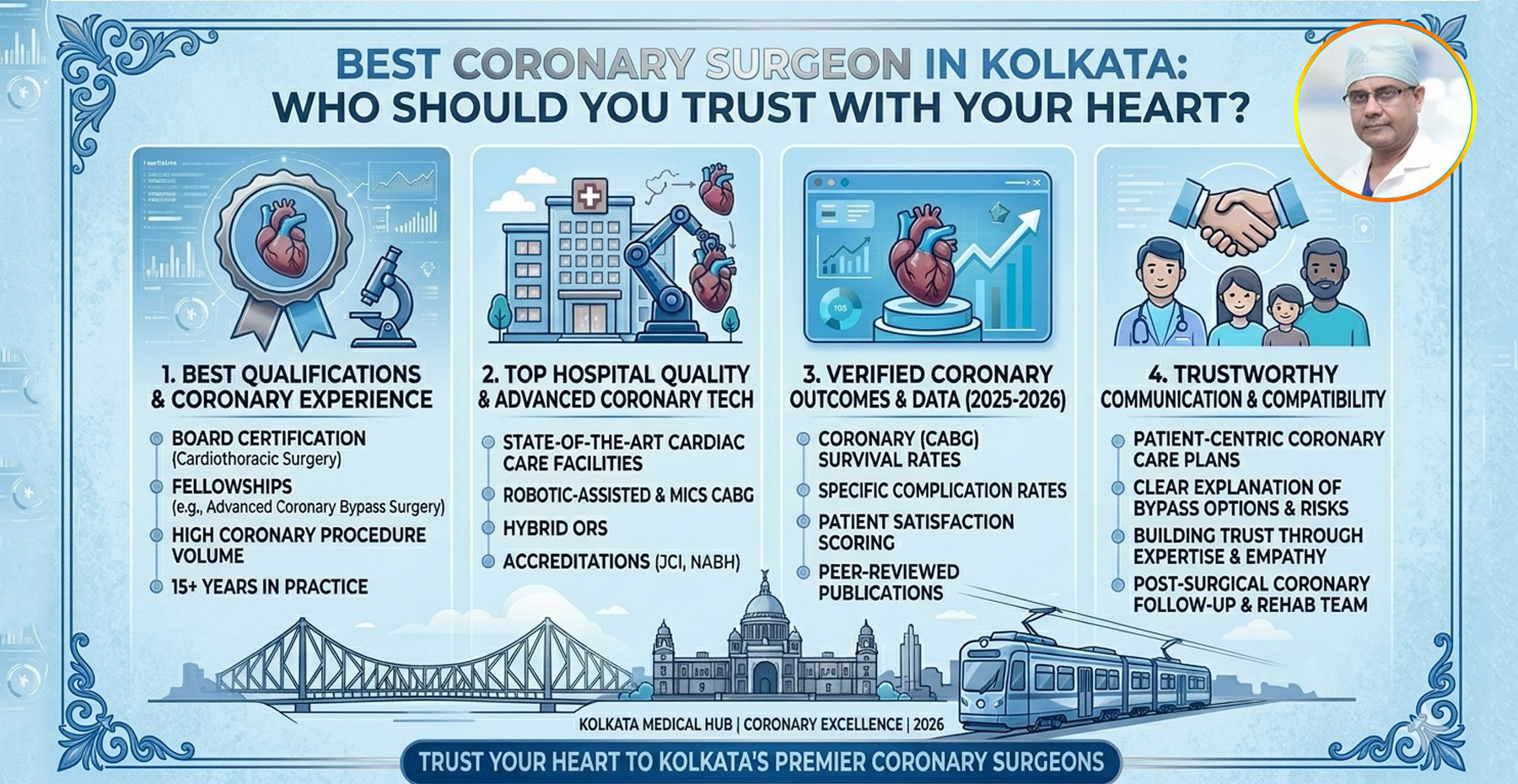
An exclusive guide to choose ‘Best Coronary Surgeon in Kolkata: Who Should You Trust with Your Heart?’
If you are reading this, chances are you or someone you love has just heard the words no one ever wants to hear: “You need heart surgery.” In that moment, the world feels like it stops. Your mind probably raced to a thousand different places—your family, your work, and the overwhelming fear of the unknown. But the biggest question usually follows the initial shock: Who is the best coronary surgeon in Kolkata, and can I really trust them with my life?
Choosing a coronary surgeon in Kolkata isn’t like picking a regular doctor. It is one of the most significant decisions you will ever make. It is a choice that balances technical precision with human empathy. In this ultimate guide, we are going to look past the hospital billboards and the glossy brochures. We will explore what really happens behind the swinging doors of the Operation Theater (OT) and how you can find a surgeon who doesn’t just see a “case,” but sees a person.
The Quiet Crisis: Why Your Choice Matters More Than Ever in 2026
We live in a city that pulses with life, from the crowded lanes of Gariahat to the high-rises of New Town. But there is a quieter, more dangerous pulse beneath the surface. In 2026, heart disease has become the leading health challenge in West Bengal. Recent data shows that nearly one in ten adults in Eastern India is living with some form of cardiovascular disease. Even more concerning is that we are seeing heart issues in people in their 30s and 40s—the prime of their working lives.
When your heart’s “plumbing”—the coronary arteries—gets blocked, the stakes are incredibly high. Kolkata has evolved into a global hub for cardiac care, but with so many options, the “paradox of choice” sets in. You see famous names and massive hospital buildings, but how do you know which coronary surgeon in Kolkata is the right fit for your specific heart?
The “Mukherjee Family” Scenario: A Lesson in Trust
Imagine a 52-year-old bank manager, let’s call him Mr. Mukherjee. He’s active, loves his Sunday biryani, and never missed a day of work. Suddenly, a routine check-up reveals three major blockages. His family is in a panic. They spend nights on Google, searching for the “best doctor.” They get ten different names from ten different relatives.
This is where the confusion starts. Is the “best” surgeon the one with the most degrees? The one who is the most famous on TV? Or the one who actually takes the time to explain how they will sew a new vessel onto a beating heart? This guide is designed to help families like the Mukherjees navigate this emotional minefield.
The Evolution of Heart Surgery in Kolkata: From 1950 to 2026
To understand where we are today, we have to look at how far we’ve come. Heart surgery in Kolkata has a rich history. Decades ago, a bypass was a massive, high-risk ordeal that kept you in the hospital for weeks.
The Shift to “Beating Heart” Surgery
In the past, the standard was to stop the heart entirely and put the patient on a “heart-lung machine.” While effective, it often led to a longer recovery and more “brain fog” after surgery. Today, the landscape has changed. Leading surgeons, including , Dr. Arup Kumar Ghosh, have championed the move toward Off-Pump Coronary Artery Bypass (OPCAB).
In this method, the heart keeps beating while we perform the bypass. It requires a much higher level of manual dexterity from the surgeon, but for the patient, it means:
- Less blood loss.
- Lower risk of stroke.
- Faster recovery.
- Fewer complications for those with kidney or lung issues.
The Rise of Robotic and Minimally Invasive Options
As we move through 2026, we are also seeing the integration of robotics. While not every patient is a candidate for robotic surgery, it has paved the way for “Keyhole” or Minimally Invasive Cardiac Surgery (MICS). Instead of a 10-inch incision through the breastbone, we can sometimes work through a small 2-inch gap between the ribs. This isn’t just about “looking better” with a smaller scar; it’s about getting you back to your life in half the time.
Pillar 1: What Truly Makes the “Best” Coronary Surgeon in Kolkata?
When people search for a coronary surgeon in Kolkata, they often look at years of experience. While that is vital, it is only one piece of the puzzle. An elite surgeon is a combination of three distinct pillars: Technical Mastery, Clinical Judgment, and Deep Empathy.
1. Technical Mastery (The “Hands”)
A heart surgeon is, at the core, a master craftsman. The coronary arteries are tiny—sometimes only 1.5 to 2 millimeters in diameter. We use stitches that are thinner than a human hair.
- The Survival Rate Myth: Many hospitals tout a “100% survival rate.” While that sounds great, you need to look closer. A surgeon who takes on only “easy” cases will have a high survival rate. The truly great surgeons are those who take on high-risk, complex cases—patients who were turned away elsewhere—and still achieve exceptional outcomes.
- Total Arterial Grafting: Does the surgeon use veins from the leg, or do they use arteries from the chest and arms? Research shows that arterial grafts last much longer (often 20+ years) compared to leg veins. A top-tier coronary surgeon in Kolkata will prioritize “Total Arterial Grafting” whenever possible.
2. Clinical Judgment (The “Brain”)
Surgery isn’t just about what happens in the OT; it’s about the decision-making before the first incision is made.
- Knowing When NOT to Operate: Sometimes, the best surgery is no surgery at all. A trusted surgeon will be honest if a patient is better served by advanced medication or a stent (angioplasty) rather than a full bypass.
- Customizing the Plan: Every heart is different. A “cookie-cutter” approach doesn’t work. The surgeon should be able to explain exactly why they chose a specific technique for your heart.
3. Deep Empathy (The “Heart”)
This is the most underrated quality. You are putting your life in someone’s hands. You deserve a surgeon who:
- Listens to your fears without checking their watch.
- Explains the procedure in a way that your 14-year-old grandson could understand.
- Is available to your family when things get stressful.
Pillar 2: Understanding the Procedures (In Layman’s Terms)
If you are looking for a coronary surgeon in Kolkata, you will hear a lot of acronyms: CABG, MICS, OPCAB, TAVI. Let’s break these down so you can actually participate in the conversation with your doctor.
CABG: The Gold Standard
Coronary Artery Bypass Grafting (CABG) is the technical name for a “Bypass.” Think of it like a traffic jam on the bypass road (pardon the pun). If one road is blocked, we build a new flyover to let the blood flow freely to the heart muscle.
- Traditional CABG: Still used for very complex cases where the heart needs to be still.
- Off-Pump CABG: The heart stays beating. This is my preferred method for over 99% of my cases because of the superior recovery profile.
Minimally Invasive Bypass (MICS)
This is the “Keyhole” surgery mentioned earlier.
- Pros: No bone cutting, less pain, 1-week recovery instead of 6 weeks.
- Cons: Not suitable for patients with blockages in all three main arteries or those with very weak heart muscles.
Redo Surgery: The Ultimate Test of Skill
Sometimes, a bypass performed 15 or 20 years ago starts to fail. Performing surgery a second time (a “Redo”) is incredibly difficult because of scar tissue. When searching for the best coronary surgeon in Kolkata, always ask if they have experience in “Redo CABG.” This is where true surgical expertise is tested.
Pillar 3: Why Narayana Hospital (RN Tagore) is a Beacon of Care in 2026
As a Senior Consultant at Narayana Health (Rabindranath Tagore International Institute of Cardiac Sciences), I see hundreds of patients every month. Why does the hospital matter as much as the surgeon?
The “Team” Concept
A surgeon is like a pilot. No matter how good the pilot is, they can’t fly the plane without a co-pilot, a navigator, and a ground crew. At Narayana, we have:
- Dedicated Cardiac Anesthetists: These specialists manage your heart’s rhythm and blood pressure while I operate.
- Specialized Cardiac Nurses: They are the ones who watch over you every second in the ICU.
- Advanced Infrastructure: In 2026, our OTs are equipped with real-time 3D mapping and hybrid technology, allowing us to perform complex procedures with pinpoint accuracy.
The Volume-to-Outcome Ratio
There is a saying in medicine: “Practice makes perfect.” Hospitals that perform thousands of heart surgeries every year generally have better outcomes because the entire system—from the pharmacy to the physical therapy team—is “tuned” to heart care. Narayana RTIICS remains one of the highest-volume cardiac centers in the world, which translates directly to safer surgeries for you.
Pillar 4: Common Mistakes Families Make When Choosing a Surgeon
In my 22+ years of experience, I’ve seen families make the same three mistakes over and over. Avoiding these can save you a lot of heartache (literally).
Choosing Based on “Star Power” Alone
Just because a doctor is famous doesn’t mean they are the best fit for your specific surgery. Some “stars” are rarely in the hospital or delegate the actual surgery to juniors. You want a surgeon who is “hands-on” and will be there for your post-op check-ups.
Ignoring the “Vibe”
If a surgeon makes you feel like a number or gets annoyed when you ask questions, walk away. Trust is a chemical reaction. If you don’t feel it during the first consultation, you won’t feel it when you are on the operating table.
Only Looking at the Total Cost
I understand that finances are a major concern. However, “cheap” surgery can be very expensive in the long run if there are complications or if the bypass grafts don’t last. In Kolkata, the cost of a bypass in 2026 ranges from ₹2.5 lakhs to ₹6 lakhs depending on the technology used. Look for value, not just the lowest price.
Pillar 5: Preparing for the Big Day—The Roadmap to the OT
The days leading up to a heart surgery can feel like a blur of tests, paperwork, and restless nights. As a coronary surgeon in Kolkata, I’ve seen that the patients who recover the fastest are often those who were the best prepared—not just physically, but mentally and logistically.
The Physical Prep: Tuning the Engine
Before we can bypass your blockages, we need to ensure the rest of your body is in peak condition to support the healing process.
- Smoking Cessation: This is non-negotiable. Smoking narrows your blood vessels and irritates your lungs. If you are scheduled for surgery, you must stop smoking at least two weeks prior to reduce the risk of post-op pneumonia.
- Diabetes Management: High blood sugar acts like sandpaper on your healing incisions. We work closely with endocrinologists to ensure your HbA1c is within a safe range before we proceed.
- Dental Clearance: It sounds strange, but a tooth infection can travel through your bloodstream and settle in your heart. We often ask for a dental check-up to rule out any “hidden” infections.
The Logistics of Care in Kolkata
Choosing a coronary surgeon in Kolkata also means navigating our city’s specific healthcare system.
- Insurance and TPA: Whether you are using a corporate policy or a government scheme like Swasthya Sathi or Ayushman Bharat, get your pre-authorization done early. In 2026, most top hospitals like Narayana have dedicated help desks to handle this, so you don’t have to run from pillar to post.
- Blood Donation: While we use blood-saving techniques (like Cell Salvage), we still ask families to arrange for a few donors as a safety net.
Mental Fortitude: The “Heart-Mind” Connection
I tell my patients that 50% of the success is my work in the OT, and the other 50% is their will to get better.
- Anxiety is Normal: Don’t suppress it. Talk to your surgeon. Ask to see the ICU. Familiarity breeds comfort.
- The Support System: Identify your “Primary Caregiver.” This is the person who will be your voice in the hospital and your cheerleader at home.
Pillar 6: Life After Bypass—The Recovery Timeline (2026 Edition)
One of the most common questions I get as a coronary surgeon in Kolkata is, “When can I go back to the office?” or “When can I drive my car?” Recovery is a marathon, not a sprint.
The First 48 Hours: The Intensive Care Unit (ICU)
In the ICU, you are the most important person in the building. You’ll be connected to monitors that track every heartbeat.
- Waking Up: You will have a tube in your throat to help you breathe for the first few hours. It’s uncomfortable, but it’s temporary.
- Early Mobilization: In 2026, we don’t believe in bed rest. We usually have you sitting up in a chair within 24 hours of a beating-heart surgery. Moving your legs prevents blood clots.
Days 3 to 6: The Step-Down Ward
This is where the real “work” begins.
- Physiotherapy: You will learn how to cough while “hugging a pillow” (to protect your chest bone) and use a spirometer to keep your lungs clear.
- Dietary Shifts: Hospital food isn’t exactly a five-star meal at Park Street, but it’s designed to be low-sodium and heart-healthy. This is the blueprint for your diet going forward.
The First Month at Home: Finding Your New Normal
Once you are back home in South Kolkata or Salt Lake, the environment changes, but the rules don’t.
- The “Sternal” Precautions: If we opened your breastbone, it takes about 6 to 8 weeks to heal completely. Avoid lifting anything heavier than a bucket of water.
- Depression and “Blues”: It is very common to feel a bit low or teary-eyed after heart surgery. It’s a physiological reaction to the trauma. It usually passes, but keep your family in the loop.
Pillar 7: 2026 and Beyond—The Future of Heart Care in Kolkata
We are at the dawn of a new era. If you are looking for a coronary surgeon in Kolkata today, you aren’t just getting the skills of 20 years ago; you are getting the technology of tomorrow.
The Rise of Hybrid Revascularization
Sometimes, a patient has one blockage that is best treated with a stent and two others that need a bypass. In our “Hybrid OTs,” we can do both in the same session. This combines the best of both worlds: the durability of surgery and the low impact of a stent.
TAVI/TAVR: The “No-Cut” Valve Replacement
For our elderly patients, especially those over 75, we now offer Transcatheter Aortic Valve Replacement (TAVI). We replace the heart valve through a small puncture in the leg, much like an angioplasty. No large incisions, no heart-lung machine. It’s a game-changer for high-risk individuals.
AI-Assisted Diagnostics and Remote Monitoring
In 2026, your recovery doesn’t end when you leave the hospital. We now use wearable devices that sync with our hospital’s AI platform. If your heart rhythm shows a slight anomaly while you’re at home in Howrah, our team gets an alert before you even feel a symptom.
Actionable Tutorial: Your 5-Step Guide to Choosing Your Surgeon
If you are currently searching for a coronary surgeon in Kolkata, follow this checklist to ensure you are making an informed choice.
Step 1: Verify the Credentials
Don’t just look for “M.S.” or “M.Ch.” Look for international fellowships or specialized training in Off-Pump (Beating Heart) surgery. Look for a surgeon who is a member of the IACTS (Indian Association of Cardiovascular-Thoracic Surgeons).
Step 2: Ask the “Hard” Questions
During your consultation, ask:
- “How many off-pump bypasses do you perform annually?”
- “What is your strategy for total arterial grafting?”
- “Who will be the lead in my post-operative care?”
Step 3: Check the Hospital Infrastructure
A great surgeon in a poorly equipped hospital is a risk. Ensure the facility has a dedicated 24/7 Cardiac ICU and a 24-hour blood bank. For coronary surgeon in Kolkata searches, hospitals like Narayana RTIICS are the gold standard because of their infrastructure.
Step 4: Seek a Second Opinion (Without Fear)
Any confident surgeon will welcome a second opinion. If a doctor tries to “pressure” you into surgery immediately (unless it’s an emergency), take a step back.
Step 5: Trust Your Instincts
After all the data is collected, listen to your gut. Do you feel safe? Do you feel heard?
Expert Tips & Frequently Asked Questions (FAQs)
What is “Beating Heart Surgery” and is it available in Kolkata?
Yes, Beating Heart Surgery (Off-Pump CABG) is widely available and preferred by top surgeons like Dr. Arup Kumar Ghosh. Unlike traditional surgery, the heart is not stopped, and a heart-lung machine is not used. This significantly reduces complications like strokes or kidney issues and is particularly recommended for elderly patients or those with multiple comorbidities.
Why is “Total Arterial Grafting” (TAG) recommended for younger patients?
Total Arterial Grafting uses only arteries (like the Mammary Artery) instead of leg veins. Arteries are naturally designed to handle high blood pressure and have a 90% success rate even after 20 years. Experts like Dr. Arup Ghosh prioritize this technique in Kolkata to ensure the patient doesn’t require a “redo” surgery later in life.
Does Dr. Arup Kumar Ghosh perform heart transplants in Kolkata?
Yes, Dr. Arup Kumar Ghosh is a Senior Consultant at RTTICS Kolkata with specialized expertise in advanced heart failure surgeries, including Heart Transplants and Ventricular Assist Devices (LVAD). He is one of the few surgeons in Eastern India trained to handle end-stage heart failure cases that cannot be managed by bypass or stents alone.
What is the success rate of Dr. Arup Ghosh for bypass surgery?
Dr. Arup Kumar Ghosh maintains an impeccable track record with a 100% survival rate in coronary artery bypass surgery (CABG). His meticulous approach, particularly in performing 99% of his cases “off-pump” using multiple arterial grafts, ensures superior long-term clinical outcomes for his patients.
When should I choose a heart valve repair over a replacement?
Repair is always preferred over replacement because it preserves your natural heart tissue and eliminates the need for lifelong blood thinners. In Kolkata, Dr. Arup Ghosh is highly recommended for Mitral and Tricuspid valve repairs, using minimally invasive techniques to ensure faster recovery and better heart function.
Conclusion: A New Lease on Life
Choosing the right coronary surgeon in Kolkata is about more than just surviving a procedure; it’s about thriving afterward. It’s about being able to walk your daughter down the aisle, playing football with your grandkids, or simply enjoying a quiet morning tea on your balcony without chest pain.
If you or your family are facing this journey, remember that you are not alone. Our city has some of the finest medical minds and most advanced technology in the world. With the right surgeon, the right hospital, and a positive mindset, this “heart problem” isn’t an end—it’s a new beginning.
Your heart has taken care of you for a lifetime. Now, it’s your turn to take care of it. Choose wisely, stay informed, and here is to many more healthy beats.
Disclaimer: This article is for informational purposes only and does not constitute medical advice. Always consult with a qualified cardiac specialist for diagnosis and treatment related to your personal health condition.
Follow Dr. Arup Kumar Ghosh on Facebook & Youtube for regular updates.
Read Also:
- Mitral Valve Disease: Causes, Symptoms & Treatment Options
- Life After Heart Surgery: The Ultimate Guide
- How to Choose the Right Cardiothoracic Surgeon in Kolkata: The 2026 Ultimate Guide
- Why Coronary Surgery in Kolkata Is Considered One of the Most Advanced in India
- Patient Guide to Valve Replacement Surgery in Kolkata
- Advanced Aortic Surgery Options Now Available in Kolkata
- Why Patients Prefer Kolkata for Complex Aortic Valve Surgeries
- A Cardiac Surgeon’s Guide to Common Heart Diseases and Treatment for Adults in Bangladesh
- Available Modern Heart Surgery Treatment in Agartala, Tripura in 2026
- How Advanced Cardiac Surgery is Transforming Healthcare in Bihar 2026
- When Should You Consult a Cardiothoracic Surgeon in Kolkata

Comments are closed