
Subtotal ₹0.00 Subtotal: ₹0.00



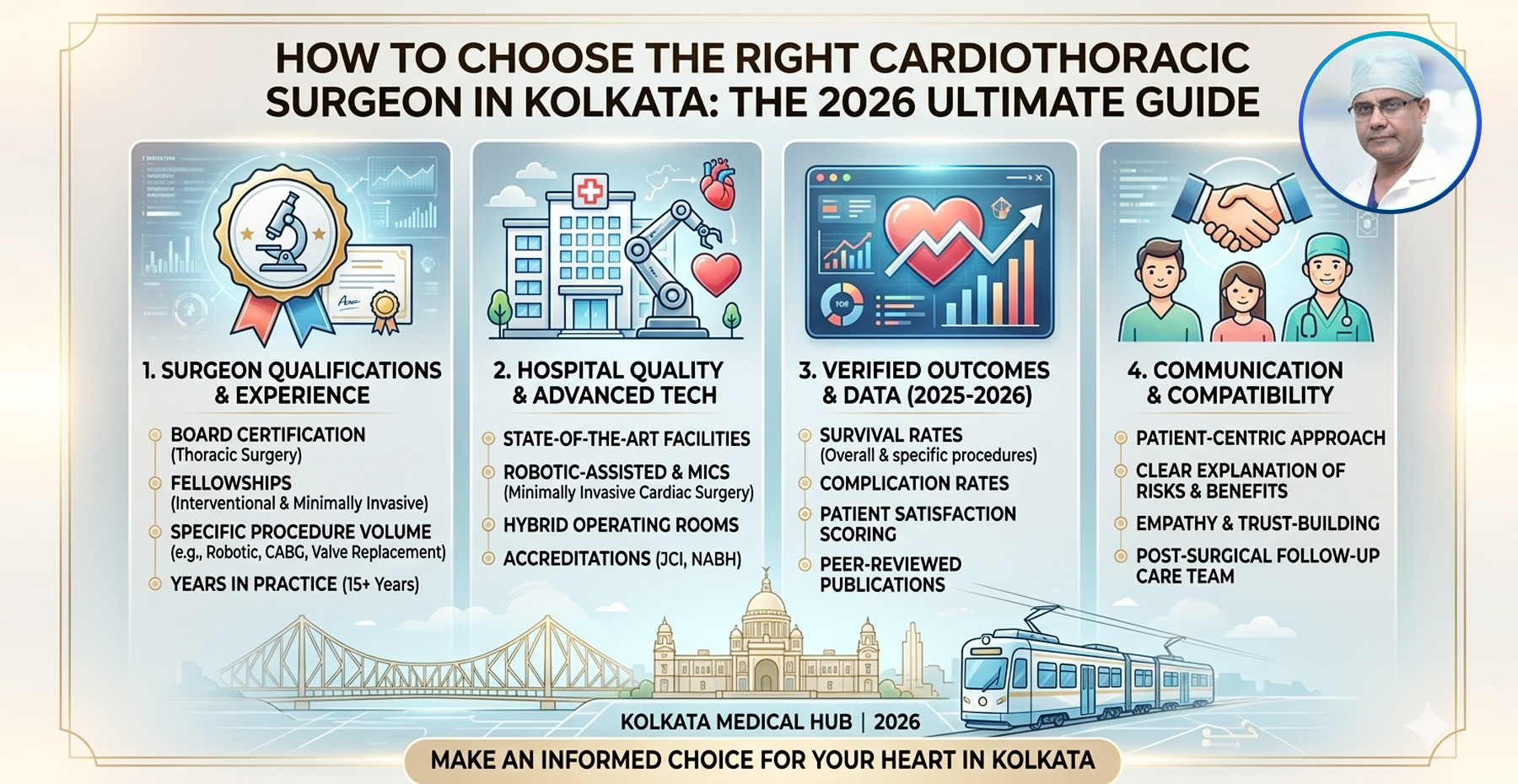
Table of Contents
Toggle“How to Choose the Right Cardiothoracic Surgeon in Kolkata: The 2026 Ultimate Guide” by Dr. Arup Kumar Ghosh, Renowned Coronary Surgeon in Narayana RN Tagore Hospital, Mukundapur, Kolkata
Finding out you or a loved one needs heart surgery is a moment that stays with you forever. The room suddenly feels a little smaller, the doctor’s voice sounds like it’s coming from miles away, and your mind starts racing. In my 34 years of standing at the operating table, I have seen thousands of patients face this exact moment. You aren’t just looking for a doctor; you are looking for a pair of hands you can trust with your life. If you are searching for a cardiothoracic surgeon in Kolkata, you are already in one of the world’s most advanced medical hubs, but the sheer number of choices can feel overwhelming.
This guide isn’t just a list of medical degrees. It is a roadmap born from decades of experience at Narayana Hospital and international centers like Papworth in the UK. I want to help you cut through the technical jargon and the hospital brochures to find the person who will not only fix your heart but also guide your family through the recovery. Choosing the right cardiothoracic surgeon in Kolkata is about more than just checking a website; it’s about understanding the balance between cutting-edge technology and human empathy.
1. The Weight of the Decision: Why This Matters Right Now
There was a time, not too long ago, when heart surgery in Kolkata meant one thing: a large incision, a long hospital stay, and months of painful recovery. But it’s 2026. The landscape has shifted dramatically. Today, we have robots helping us sew tiny arteries and AI programs that help us predict exactly how a patient will recover before we even make the first cut.
However, as technology gets better, the “human” choice becomes even more critical. In a city like Kolkata, where heart disease is unfortunately common due to lifestyle and genetic factors, the demand for specialists is at an all-time high. But here is a hard truth: not every surgeon is the right fit for every heart. Some specialize in complex valve repairs, while others are masters of the “off-pump” bypass.
Right now, we are seeing a rise in younger patients—people in their 30s and 40s—requiring intervention. For them, the choice of surgeon determines whether they can return to a full, active life or if they will be sidelined by complications. This guide exists to ensure you make that choice with confidence, not fear.
2. The Evolution of Heart Care in Kolkata: From Scalpels to Silicon
To understand how to pick a surgeon, we have to look at how far we’ve come. Kolkata has always been the medical capital of Eastern India. We have a history of “firsts” here. But in the last decade, and especially leading into 2026, the city has seen a massive influx of global talent and 5G-enabled medical infrastructure.
The Shift to Minimally Invasive Surgery (MICS)
Years ago, every patient left the hospital with a “zipper” scar down the middle of their chest. Today, many of my colleagues and I perform surgery through incisions no larger than a few centimeters. This isn’t just about looks; it’s about getting you back to your family in days instead of weeks. When looking for a cardiothoracic surgeon in Kolkata, you need to ask if they are proficient in MICS.
The Rise of the Robotic Assistant
In 2026, the da Vinci robotic system is no longer a luxury; it’s a standard tool for complex cases at Narayana Hospital and other top centers. A surgeon using a robot has a 3D, high-definition view that the human eye simply cannot match. It allows for precision that was once thought impossible. If your case is complex, finding a surgeon who embraces this technology is a significant advantage.
Why Kolkata is Now a Global Destination
It’s not just locals seeking care here. We see patients from across Southeast Asia and Bangladesh. This “high-volume” environment is actually good for you. In surgery, practice doesn’t just make perfect; it makes for safety. A surgeon who operates daily is much better prepared for the unexpected than one who operates once a week.
3. Pillar One: Credentials and the “Global Experience” Factor
When you look at a doctor’s profile, you’ll see a lot of letters: MBBS, MS, MCh, FRCS. What do they actually mean for your surgery?
The Importance of International Exposure
I spent a decade working within the NHS in the United Kingdom. Why does this matter for a patient in Kolkata? Because international fellowships, especially in places like Papworth or the Royal Brompton, expose a surgeon to global protocols and the highest standards of safety.
- FRCS (Edinburgh/Glasgow): This indicates that the surgeon has passed the rigorous standards of the Royal College of Surgeons. It’s a mark of global competency.
- CCST (UK): This stands for Certificate of Completion of Specialist Training. It means the surgeon has been vetted by international boards to lead a surgical team.
The “Sub-Specialty” Trap
“Cardiothoracic” is a broad term. It covers the heart (cardio) and the lungs (thoracic).
- Adult Cardiac Surgeons: Focus on bypasses and valves.
- Congenital/Pediatric Surgeons: Focus on heart defects in children.
- Thoracic Surgeons: Focus on lung tumors and chest wall issues.
Common Mistake: Choosing a generalist for a highly specific problem. If you need a mitral valve repair, you want someone who does 100 of those a year, not someone who “mostly does bypasses but can do valves too.”
4. Pillar Two: The “High-Volume” Center vs. The Surgeon
You might find a brilliant surgeon, but if they are operating in a facility without a dedicated Cardiac ICU or 24/7 imaging, you are at risk. Surgery is a team sport.
The Role of the Anesthetist and Perfusionist
While the surgeon gets the credit, the cardiac anesthetist and the perfusionist (the person who runs the heart-lung machine) are the ones who keep you stable. High-volume centers like Narayana Hospital have teams that have worked together for years. They speak a silent language in the OR. That level of “team-sync” saves lives during critical moments.
Success Rates: The 99% Benchmark
In 2026, the success rate for a standard CABG (bypass surgery) in a top-tier Kolkata hospital should exceed 99%. If a surgeon or hospital is hesitant to share their data on mortality and infection rates, that is a red flag. Transparency is the hallmark of a confident professional.
5. Pillar Three: Decoding Technology – Does Your Surgeon Use AI?
We are now in the era of “Precision Heart Care.” When you interview a potential cardiothoracic surgeon in Kolkata, ask about the tools they use before the surgery begins.
AI-Driven Risk Scoring
In the past, we guessed a patient’s risk based on age and basic health. Now, we use AI algorithms that look at thousands of data points—your bloodwork, your genetics, and your lifestyle—to give us a precise risk score. This helps us decide if you are a better candidate for a stent or a full bypass.
3D Printing and VR
For very complex “redo” surgeries (where a patient is having their second or third heart operation), we sometimes 3D-print a model of that specific patient’s heart. It allows us to “practice” the surgery before we ever touch the patient.
Virtual Reality (VR) in the OR
Some surgeons now use VR headsets to view a patient’s internal anatomy in real-time during the operation. This “X-ray vision” helps us navigate around scar tissue from previous surgeries. While this sounds like science fiction, it is the reality of 2026 cardiac care in Kolkata.
6. Pillar Four: Communication and the “Gut Feeling”
Medicine is as much about the soul as it is about biology. You should never feel like a “case number” or “the bypass in Room 402.”
The 10-Minute Test
During your first consultation, notice how the surgeon talks to you.
- Do they look you in the eye?
- Do they use words you understand, or do they hide behind medical jargon?
- Do they acknowledge your fear?
A surgeon who cannot communicate with you in the office is unlikely to communicate well with your family during a crisis. If they seem rushed or dismissive, keep looking. There are plenty of brilliant surgeons who are also kind humans.
Managing Expectations
A good surgeon will tell you what they can’t do as clearly as what they can do. If a doctor promises a “100% guarantee” with no risks, be careful. Surgery always involves risk. The right surgeon will explain those risks and tell you exactly how they plan to minimize them.
7. Pillar Five: The Hospital Ecosystem and Post-Op Care
The surgery is only half the battle. The real work begins in the recovery room.
Cardiac Rehabilitation (Rehab)
In 2026, recovery doesn’t end when you leave the hospital. Top surgeons in Kolkata now prescribe digital rehab programs. You might wear a smartwatch that sends your heart rhythm directly to the hospital team. If your heart rate spikes or you stop moving, we know immediately.
The “Redo” Capability
Does the hospital have the infrastructure to handle a complication at 3 AM? You want a hospital with a dedicated “Code Blue” team and a surgical team on-call 24/7. Choosing a surgeon who practices at a small nursing home might save you money, but it could cost you vital minutes if something goes wrong.
8. Pillar Six: Navigating the Financial Maze of Heart Surgery in 2026
When we talk about choosing a cardiothoracic surgeon in Kolkata, we cannot ignore the elephant in the room: the cost. In 2026, healthcare financing has become as complex as the surgery itself. However, a hallmark of a truly expert surgeon is transparency. You should never feel like you are haggling over a price; you should feel like you are investing in a clear, clinical outcome.
Understanding the 2026 Cost Spectrum in Kolkata
In the current medical landscape, the cost of cardiac surgery at top-tier institutions like Narayana Hospital is divided into distinct categories based on technology and room choice.
- Conventional CABG (Bypass): In a general ward setting, this typically ranges between ₹1.8L to ₹2.8L. This is the gold standard for many and remains highly accessible.
- Minimally Invasive (MICS): Because this requires specialized instruments and shorter but more intensive ICU care, costs range from ₹2.8L to ₹5.5L.
- Robotic-Assisted Surgery: Utilizing the da Vinci system for maximum precision usually brings the total to ₹4.5L to ₹8.5L.
The “Hidden Cost” Checklist
Many patients focus only on the surgery fee. To avoid financial stress during recovery, ensure your surgeon’s team provides a breakdown that includes:
- Graft/Valve Materials: Are you using a mechanical valve or a bioprosthetic one? The cost difference can be significant.
- ICU Stay Extensions: If a patient requires more than the standard 48 hours in the Cardiac ICU, how does the billing change?
- Pharmacy and Consumables: In 2026, some advanced blood-thinning medications or specialized sutures are billed separately. Ask for an “all-inclusive” estimate.
Insurance and Government Schemes (CGHS/ECHS/Swasthya Sathi)
Kolkata is unique because of the wide adoption of the Swasthya Sathi scheme and central government health schemes. A reputable cardiothoracic surgeon in Kolkata will have a dedicated desk to help you navigate these. At Narayana, we ensure that patients under these schemes receive the same clinical excellence as private patients. The only difference is the paperwork—not the stitches.
9. Pillar Seven: The Power of the Second Opinion – Why It’s a Safety Net, Not an Insult
I always tell my patients: “If a surgeon is offended by you seeking a second opinion, they are probably not the right surgeon for you.” In 2026, medicine is collaborative.
When to Seek a Second Opinion
- The “Urgency” vs. “Emergency” Confusion: Unless you are in the middle of a heart attack, most heart surgeries are “urgent,” not “emergencies.” You usually have 48 to 72 hours to talk to another expert.
- Recommendation for a “Redo”: If you’ve had surgery before and need a second intervention, the complexity increases tenfold. You need a specialist who focuses on complex redo-cases.
- High-Risk Profiles: If the patient is over 80 or has severe kidney issues, different surgeons may have different “risk appetites.”
How to Present Your Case to a Second Surgeon
Don’t just bring the papers. Bring the story. Explain your lifestyle, your fears, and what the first surgeon suggested. A second opinion often confirms the first, which gives the patient an incredible amount of psychological peace before going under the knife.
10. Pillar Eight: The “Off-Pump” Revolution – Why It’s the Kolkata Gold Standard
One of the most significant technical choices you will discuss with a cardiothoracic surgeon in Kolkata is whether the surgery will be “On-Pump” or “Off-Pump.”
On-Pump vs. Off-Pump: What You Need to Know
Historically, we stopped the heart and used a heart-lung machine (the “pump”) to keep the patient alive. While effective, it can sometimes cause a systemic inflammatory response.
Off-Pump surgery (Beating Heart Surgery) allows us to operate while the heart is still pulsing.
[Image showing the ‘Off-Pump’ surgical technique versus the heart-lung machine bypass]
Why I Champion the Off-Pump Approach
In my practice, 99% of bypass surgeries are performed off-pump. Why?
- Lower Stroke Risk: There is less manipulation of the aorta.
- Kidney Protection: It is much gentler on the renal system, which is vital for elderly patients.
- Faster Recovery: Patients generally wake up sooner and require less blood transfusion.
When choosing your surgeon, ask: “What percentage of your cases are performed off-pump, and why would you choose one over the other for my specific case?”
11. Actionable Tutorial: The 48-Hour Decision Matrix
If you have just received a diagnosis requiring surgery, follow these steps to choose your surgeon within the next 48 hours without panicking.
Step 1: The Digital Audit (Hours 1–4)
Don’t just look at Google Reviews; they can be gamed. Look for:
- Research Papers: Has the surgeon published recently? This shows they stay updated on 2026 trends.
- Hospital Affiliation: Are they at a “Center of Excellence”?
- Video Content: Watch them speak. Do they sound like someone you can trust?
Step 2: The Consultation Prep (Hours 4–8)
Write down three non-negotiables. For example:
- “I want a minimally invasive approach.”
- “I need to be back at work in 30 days.”
- “I have a limited budget of ₹4 Lakhs.”
Step 3: The “Deep-Dive” Interview (Hours 24–30)
Book your consultation. Ask these three critical questions:
- “How many times have you performed this exact procedure in the last 12 months?”
- “What is your personal complication rate for this surgery?”
- “Who is your lead anesthetist, and how long have you worked together?”
Step 4: The Facility Tour (Hours 30–36)
Walk through the hospital. Is it clean? Are the staff helpful? Most importantly, check the Cardiac ICU (CT-ICU). This is where the patient will spend the most critical hours of their life. If it looks chaotic, reconsider.
12. Expert Tips for the “Kolkata Patient”
Having treated thousands of people in this city, I’ve noticed a few things unique to our culture that can affect your choice of surgeon.
- The Family Factor: In Kolkata, surgery isn’t just for the patient; it’s for the whole family. Choose a surgeon who is willing to talk to the “extended family.” You need someone who can manage the emotional weight of ten concerned relatives with grace.
- The Post-Surgical Diet: We love our food in Bengal. Ask your surgeon if they have a dedicated nutritionist who understands the local palate. Recovery is easier when you don’t feel like you’re being punished with your diet.
- Language Comfort: While English is standard, being able to explain your pain in Bengali or Hindi often leads to better diagnostic accuracy. Don’t underestimate the power of “Bhasha” (language) in healing.
13. FAQs: What People Are Asking in 2026
Is robotic heart surgery in Kolkata better than traditional surgery?
Not always. Robotics is a tool, not a cure. It is superior for valve repairs and certain bypasses because of precision and smaller incisions. However, for a 4-vessel bypass, traditional or MICS techniques might still be the safer choice. The “best” surgery is the one that gives you the best long-term survival.
How long is the waiting list for a top cardiothoracic surgeon in Kolkata?
In 2026, high-volume centers like Narayana have optimized scheduling. For non-emergency cases, the wait is usually 7 to 14 days. If a surgeon is available “this afternoon,” it’s worth asking why their schedule is so empty.
What is the survival rate for heart surgery in Kolkata today?
For standard procedures like CABG, the survival rate in top Kolkata hospitals is now on par with the best hospitals in London or New York, hovering around 98.5% to 99.5%.
Can I travel back to my home (outside Kolkata) after surgery?
Most patients can travel by car within 7-10 days and fly within 3-4 weeks, depending on the surgeon’s clearance.
Conclusion: From Fear to Freedom
Choosing the right cardiothoracic surgeon in Kolkata is the first step toward a new lease on life. It’s natural to feel afraid, but remember that the heart is a remarkably resilient organ. With the right hands guiding the scalpel and the right technology backing them up, the “pain point” you are feeling today will soon become a distant memory.
You aren’t just choosing a surgeon to get through a surgery; you are choosing a partner for your future health. Whether it’s playing with your grandkids at Victoria Memorial or returning to your office in Sector V, your life is waiting for you on the other side of this decision.
Ready to take the next step?
Don’t let the clock tick on your heart health. If you have questions about your diagnosis or want to explore minimally invasive options, reach out for a consultation. Let’s get your heart back in rhythm.
Disclaimer: This article is for informational purposes only and does not constitute medical advice. Always consult with a qualified cardiac specialist for diagnosis and treatment related to your personal health condition.
Follow Dr. Arup Kumar Ghosh on Facebook & Youtube for regular updates.
Read Also:
- Mitral Valve Disease: Causes, Symptoms & Treatment Options
- Life After Heart Surgery: The Ultimate Guide
- Best Coronary Surgeon in Kolkata: Who Should You Trust with Your Heart?
- Why Coronary Surgery in Kolkata Is Considered One of the Most Advanced in India
- Patient Guide to Valve Replacement Surgery in Kolkata
- Advanced Aortic Surgery Options Now Available in Kolkata
- Why Patients Prefer Kolkata for Complex Aortic Valve Surgeries
- A Cardiac Surgeon’s Guide to Common Heart Diseases and Treatment for Adults in Bangladesh
- Available Modern Heart Surgery Treatment in Agartala, Tripura in 2026
- How Advanced Cardiac Surgery is Transforming Healthcare in Bihar 2026
- When Should You Consult a Cardiothoracic Surgeon in Kolkata

Comments are closed