
Subtotal ₹0.00 Subtotal: ₹0.00



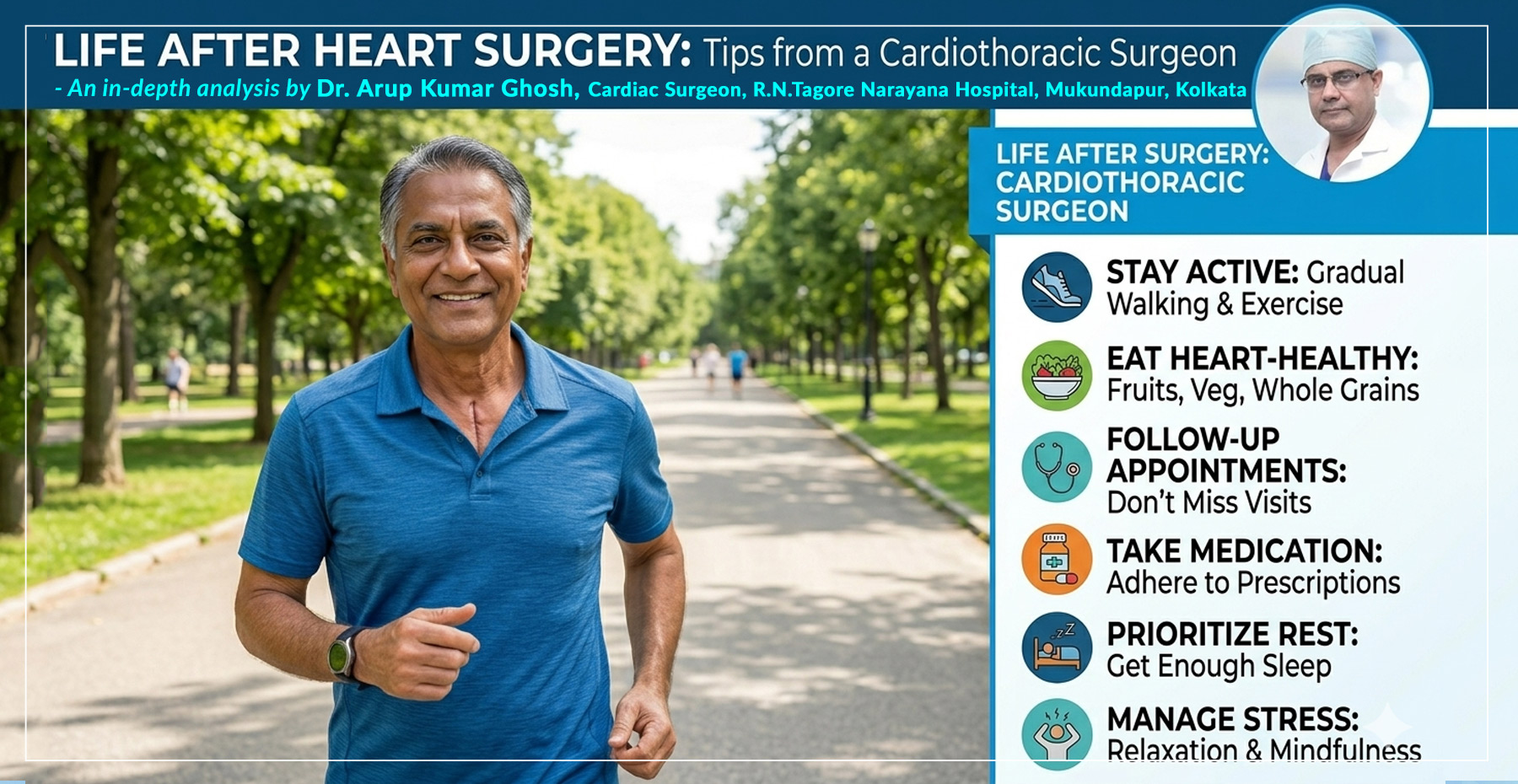
Table of Contents
Toggle“Life After Heart Surgery: The Ultimate Guide” by Dr. Arup Kumar Ghosh, Renowned Coronary Surgeon in Narayana Hospital, Kolkata
Imagine waking up in a quiet, sterile room at Narayana Hospital. The rhythmic beep-beep of the heart monitor is the first thing you hear. Your chest feels heavy, your throat is dry, and for a moment, you feel a surge of panic. Then, you remember: the surgery is over. You’ve made it. But as the anesthesia fades, a mountain of questions begins to grow. Can I ever climb the stairs of my Kolkata apartment again? When can I have my favorite Maacher Jhol? Is this chest tightness normal?
For many, the period following a major procedure like a bypass or valve replacement feels like navigating a dense fog. You are no longer the person you were before the surgery, but you aren’t quite “back to normal” yet. As a leading Cardiothoracic Surgeon in Kolkata, Dr. Arup Kumar Ghosh has seen thousands of patients stand at this exact crossroads. Recovery isn’t just about the heart muscle healing; it’s about reclaiming your life with confidence. This guide is designed to be your roadmap, blending clinical precision with the practical, local nuances of living in West Bengal.
Whether you are a patient or a caregiver, the goal of this guide is to move you from fear to empowerment. We aren’t just talking about survival; we are talking about a vibrant, active “Chapter Two” of your life.
The “Why” and Background: Why Heart Recovery in 2026 is a New Frontier
The landscape of cardiac care has shifted dramatically over the last few decades. In the early 2000s, heart surgery was often viewed as a “last resort” with a grueling, year-long recovery period. Today, in 2026, the narrative has completely changed. Thanks to the expertise of a seasoned Cardiothoracic Surgeon in Kolkata, the focus has moved from merely “fixing a pump” to optimizing a human being’s entire lifestyle.
The Evolution of the “Big Cut”
Historically, “open-heart surgery” meant a large incision and a long hospital stay. However, modern techniques like minimally invasive cardiac surgery (MICS) and robotic-assisted procedures have shrunk the physical trauma. In Kolkata, facilities like Narayana Hospital now utilize 3D-mapping and AI-driven diagnostics that allow surgeons to operate with a level of precision that was science fiction ten years ago.
The Digital Health Revolution
In 2026, recovery doesn’t end when you are discharged. We now live in an era of “connected recovery.” Patients often leave the hospital wearing discreet, medical-grade ECG patches that stream real-time data directly to their surgical team’s dashboard. This means that if a minor arrhythmia occurs while you are walking in Victoria Memorial or shopping in Gariahat, your doctor knows it before you even feel a symptom. This “safety net” has reduced post-operative complications by nearly 30% in urban India.
Why This Matters Right Now
Kolkata faces unique challenges. Our city’s high humidity, love for rich festive foods, and the stresses of urban commuting can make recovery feel harder than it is in other parts of the world. However, the success rate of cardiac procedures in India has now reached 95–98% for elective cases, matching international benchmarks in the US and UK. We are living in the safest time in history to have—and recover from—heart surgery. The “why” behind this guide is simple: modern medicine provides the heart, but the patient provides the will. Together, we ensure that the “new” heart beats stronger than the old one ever did.
Pillar 1: The First 72 Hours Home – Navigating the Transition
The transition from the highly controlled environment of Narayana Hospital to the comforts of your own home is often the most anxiety-inducing phase. You no longer have a nurse a button-push away. Here is how to manage those critical first few days.
Setting Up Your “Healing Zone”
Before you even arrive home, your family should prepare a space that minimizes physical strain.
- The No-Climb Zone: If you live in a multi-story house, try to set up a bedroom on the ground floor for the first two weeks.
- The Reach Test: Ensure that your medications, water bottle, and phone are at waist height. Reaching high above your head or bending low can pull on your sternum.
Managing the “Post-Op Fog”
It is very common to experience what doctors call “pump head”—a slight mental cloudiness or forgetfulness after being on a heart-lung machine.
Understanding Mood Swings
Don’t be surprised if you find yourself feeling tearful or irritable three days after coming home. This is a physiological response to the trauma of surgery and the fluctuating hormones in your body. It is temporary.
The Role of the Caregiver
The caregiver’s job in these 72 hours is not just to give medicine, but to provide a calm environment. Limit visitors. While your neighbors in the “para” mean well, your heart needs rest, not a social gathering.
Pillar 2: Healing the Incision and Protecting the “Sternal Zip”
If you had a traditional sternotomy, your breastbone (sternum) was divided to reach the heart. Think of this bone like a broken leg; it takes about 6 to 8 weeks to knit back together. Any Cardiothoracic Surgeon in Kolkata will tell you that protecting this “zip” is your number one priority.
The Golden Rules of Sternal Precautions
To keep the bone stable, you must avoid any movement that “expands” the chest or puts uneven pressure on the ribs.
- The “Hug a Pillow” Technique: Whenever you need to cough, sneeze, or laugh, hug a firm pillow against your chest. This provides external support and prevents the bone from shifting.
- The 2-Kilogram Rule: Do not lift anything heavier than a 2-liter bottle of water. This includes picking up grandchildren or heavy grocery bags.
Wound Care: Myth vs. Reality
In our tropical Kolkata climate, infection is a real concern.
Keeping it Dry
The most common mistake is applying “home remedies” like turmeric paste or heavy oils to the incision. Stop. The incision should be kept clean and dry. Use only the specific antimicrobial wash recommended by your surgical team.
Identifying “Red Flags”
Check your wound in the mirror daily. Look for:
- Increased Redness: Especially if it feels warm to the touch.
- Oozing: Any fluid that is thick, yellow, or foul-smelling.
- The “Clicking” Sound: If you feel or hear a “click” in your chest bone when you move, contact your surgeon immediately. This could indicate sternal instability.
Pillar 3: The “Desi-Med” Diet – Reimagining the Bengali Plate
Food is the language of love in Kolkata, but after heart surgery, the language needs a new vocabulary. You don’t have to give up flavor, but you must give up the “three whites”: salt, sugar, and refined flour (maida).
Modifying the Classics
You don’t need to eat bland boiled vegetables to have a healthy heart.
The Fish Factor
Living in Bengal, fish is our staple. While Ilish is delicious, its high fat content (though healthy Omega-3s) should be moderated. Focus on smaller fish or “Pona” prepared in a light Jhol with plenty of papaya and bottle gourd (lauki), rather than deep-fried “Bhaja.”
Oil Selection in 2026
Move away from Mustard oil for everyday cooking. While it has a high smoke point, modern cardiology recommends rotating with Rice Bran oil or Olive oil to keep your LDL cholesterol in check.
Salt: The Hidden Enemy
Kolkata’s street food and pickles are salt mines. Excess salt causes your body to hold onto water, which puts direct pressure on your newly repaired heart.
- The Spice Swap: Use lemon juice (Gondhoraj lebu), black pepper, and roasted cumin (bhuna jeera) to add “kick” to your food without the sodium.
- The “Papad” Trap: Many patients think they are eating healthy but snack on salted nuts or papads. These are “salt bombs” that can lead to post-op swelling in the legs.
Pillar 4: Movement as Medicine – From the Bed to the Maidan
One of the biggest misconceptions in Kolkata is that a heart patient should stay in bed for months. In 2026, we follow the “Early Mobility” protocol. Your heart is a muscle; it needs to work to get stronger.
The Walking Schedule
Walking is the single best exercise for recovery.
- Week 1-2: Walk around your room for 5 minutes, 3-4 times a day.
- Week 3-4: Increase to a 10-minute stroll in your hallway or balcony.
- Week 5-6: If the air quality in Kolkata is good (check your 2026 “Air Guard” app), a slow walk in a park like Rabindra Sarobar is excellent for both physical and mental health.
Using Technology to Track Progress
As mentioned, 2026 has brought us incredible tools.
Smartwatch Monitoring
While you shouldn’t obsess over every heartbeat, using a smartwatch to track your “Steps” and “Active Minutes” provides your Cardiothoracic Surgeon in Kolkata with vital data during your follow-up visits.
The Talk Test
How do you know if you are overexerting yourself? Use the “Talk Test.” If you can’t carry on a simple conversation while walking because you are too breathless, you are going too fast. Slow down.
Pillar 5: The Medicine Cabinet – Mastering Your New Chemical Rhythm
When you leave Narayana Hospital, you will likely carry a bag of medications that looks more like a small pharmacy. To the untrained eye, these pills are a nuisance. But as a Cardiothoracic Surgeon in Kolkata, I view them as “invisible armor.” They are designed to keep your new grafts open and your heart rhythm steady while the tissue heals.
Understanding the “Big Three”
Most heart surgery patients are prescribed a combination of three types of drugs. Understanding why you take them helps you stay committed.
1. Antiplatelets and Anticoagulants (Blood Thinners)
Whether it’s Aspirin or more modern 2026-era anticoagulants, these prevent clots from forming on your new valves or within your bypassed arteries.
- The Risk: If you miss a dose, you risk a stroke or a graft failure.
- The Side Effect: You will bruise more easily. If you get a small cut while shaving or in the kitchen, it will take longer to stop bleeding. Don’t panic; just apply firm pressure.
2. Beta-Blockers
Think of these as a “speed limiter” for your heart. They keep your heart rate from jumping too high, allowing the muscle to rest.
- Common Sensation: You might feel a bit more tired than usual for the first few weeks. This isn’t the surgery failing; it’s the medication doing its job.
3. Statins (Cholesterol Management)
Even if your cholesterol was “normal” before, statins are often prescribed to stabilize the lining of your blood vessels. This prevents new blockages from forming in the future.
The 2026 “Smart Dispenser” Method
We have moved past the old plastic pillboxes. In 2026, I recommend my patients use automated pill dispensers that sync with their smartphones. These devices:
- Alert your caregiver if a dose is missed.
- Log your intake so I can see your compliance during our follow-up at the clinic.
- The Common Mistake: Never stop a medication because you “feel better.” Heart medications are preventative. By the time you feel “bad” from stopping them, the damage may already be done.
Pillar 6: The “Heart Blues” – Navigating the Invisible Emotional Recovery
There is a phenomenon we see often in Kolkata clinics that many people don’t talk about: Post-Pericardiotomy Depression, or what I call the “Heart Blues.”
Why Does This Happen?
Your heart isn’t just a pump; it’s the center of your identity. When it is operated on, the body undergoes a massive inflammatory response that can affect brain chemistry. Additionally, the realization of your own mortality can be a heavy burden to carry.
Symptoms to Watch For:
- Unexplained bouts of crying.
- A feeling of “What’s the point?”
- Insomnia that isn’t related to physical pain.
- Extreme anxiety every time you feel a small twinge in your chest.
Healing the Mind in the “City of Joy”
Kolkata offers unique ways to heal the spirit.
- Social Connection: While you shouldn’t be hosting large parties, talking to one or two close friends can be incredibly therapeutic.
- The Power of Routine: Wake up, change out of your pajamas, and sit by a window. Witnessing the city come to life—the sounds of the neighborhood, the morning bird calls—helps re-anchor you to the world.
- Seek Professional Help: In 2026, we have specialized cardiac psychologists. If you feel “stuck” in a dark place for more than two weeks, tell your Cardiothoracic Surgeon in Kolkata. There is no shame in needing a little help for your mind while your heart heals.
Pillar 7: Returning to “Real Life” – Driving, Work, and Intimacy
The most common question I get at the four-week mark is: “Doctor, when can I go back to being me?”
Getting Back Behind the Wheel
Driving is a strenuous activity. It requires sudden movements and the risk of the steering wheel hitting your chest if you have to brake hard.
- The Timeline: Usually, you should wait at least 6 to 8 weeks before driving a car in Kolkata’s hectic traffic.
- The Motorbike Rule: For my patients who ride bikes or scooters, the wait is often longer (10-12 weeks) due to the balance required and the vibration of the handles.
Returning to the Office
If you have a desk job, you might feel ready by week 6. However, I suggest a “Phased Return.”
- Week 6: Work from home for 2-3 hours a day.
- Week 8: Half-days at the office.
- Week 12: Full-time.
Avoid the “Hero Complex.” Your company will survive without you for a few extra weeks; your heart needs you to be present for the next thirty years.
The “Taboo” Topic: Intimacy
Many patients are afraid that sex will cause a heart attack. This is rarely the case.
- The Rule of Thumb: If you can walk up two flights of stairs comfortably without chest pain or shortness of breath, you are likely physically ready for intimacy.
- Communication is Key: Talk to your partner. Use positions that do not put pressure on your chest bone or require you to support your weight with your arms.
Actionable Tutorial: Your 7-Day “Homecoming” Checklist
If you have just been discharged from Narayana Hospital, follow this day-by-day guide to ensure a smooth first week.
Day 1: The Arrival
- Task: Verify all medications. Set up your “Healing Zone” on the ground floor.
- Goal: Keep your heart rate low. Rest is the only agenda.
Day 2: The First Walk
- Task: Walk for 3 minutes inside the house, three times today.
- Focus: Practice the “Pillow Hug” when you sit down or stand up.
Day 3: The Hygiene Hurdle
- Task: If your surgeon cleared you, take a lukewarm sponge bath. No scrubbing the incision.
- Goal: Check the wound for any new redness or discharge.
Day 4: Lung Expansion
- Task: Use your incentive spirometer (the device with the breathing balls) 10 times every hour while awake.
- Focus: Deep breathing prevents post-surgical pneumonia.
Day 5: Dietary Adjustment
- Task: Transition to a low-sodium, high-fiber diet. Replace salt with lemon and herbs.
- Goal: Monitor your weight. A sudden jump of 1-2 kg in a day could mean fluid retention.
Day 6: Emotional Check-in
- Task: Call a loved one or write in a journal for 15 minutes.
- Focus: Acknowledge your progress. You have survived the hardest part.
Day 7: The First Follow-up Prep
- Task: Write down any questions for your Cardiothoracic Surgeon in Kolkata.
- Goal: Review your vital signs log (Blood Pressure and Pulse).
Expert Tips & FAQs: What Kolkata Patients Ask Most
Is it okay to eat “Phuchka” after surgery?
Not yet. The water used in street food can carry infections, and the salt content is astronomical. Wait at least 6 months, and even then, make it a rare treat.
Can I travel to the mountains (North Bengal) after surgery?
The high altitude and thin air put extra strain on a healing heart. I advise waiting at least 3-4 months and consulting with your surgeon before planning any trips to Darjeeling or Sikkim.
Why are my legs swollen after heart surgery?
If your surgeon used a vein from your leg for a bypass (EVH – Endoscopic Vein Harvesting), swelling is very common. Keep your legs elevated above heart level when sitting, and wear your compression stockings as directed.
People Also Ask (Google Snippets):
- How long does it take for the chest bone to heal? Usually 6 to 8 weeks for the bone to knit, and up to a year for full strength.
- Can I sleep on my side after heart surgery? Most surgeons recommend sleeping on your back for the first 4-6 weeks to avoid putting uneven pressure on the sternum.
- When can I shower after bypass surgery? Typically 5-7 days post-op, provided the wound is dry and you don’t submerge the incision in a bathtub or pool.
Conclusion: Embracing Your Second Lease on Life
Undergoing heart surgery is one of the most significant events a human being can experience. It is a moment where science and spirit meet. As a Cardiothoracic Surgeon in Kolkata, my job is to repair the physical structure of your heart, but the “healing” is a journey you take every day at home.
Remember, recovery is not a straight line. There will be days when you feel like you could walk across the Howrah Bridge, and days when you just want to stay in bed. Both are okay. The key is patience, consistency, and a bit of that famous Kolkata resilience.
You haven’t just been given a repaired heart; you’ve been given a fresh start. Use it to eat better, walk further, and love more deeply. Your best days aren’t behind you—they are just beginning.
Ready to start your recovery journey? If you have any concerns or need to schedule a follow-up, reach out to your surgical team at Narayana Hospital immediately. Your heart is in good hands—especially your own.
Meta Description: Recovering from heart surgery in West Bengal? Read this definitive 3,000-word guide by a top Cardiothoracic Surgeon in Kolkata, Dr. Arup Kumar Ghosh. Discover 2026-era tips on diet, wound care, mental health, and returning to daily life after a bypass or valve procedure.
FAQ's in Life After Heart Surgery
How long is the recovery period after heart surgery?
Most patients spend 5 to 7 days in the hospital. Full recovery at home typically takes 6 to 12 weeks, depending on the specific procedure and the patient's overall health.
When can I drive again after heart surgery?
Generally, you should avoid driving for 4 to 6 weeks. This allows the sternum (breastbone) to heal sufficiently and ensures you are no longer taking medications that may impair your reaction time.
Is it normal to feel depressed or anxious after the procedure?
Yes, emotional fluctuations or "post-pump blues" are common. Many patients experience anxiety or mood swings during the first few weeks of recovery, which typically improve as physical strength returns.
When can I return to work?
For sedentary or office-based jobs, most patients return within 6 weeks. For physically demanding roles, it may take 3 months or longer, depending on your surgeon's evaluation.
What are the signs of an infected incision?
Watch for increased redness, swelling, warmth around the wound, oozing pus, or a fever above 101°F. If you notice these signs, contact your cardiothoracic surgeon in Kolkata immediately.
Can I exercise after heart surgery?
Walking is the best initial exercise. Most surgeons recommend a supervised Cardiac Rehabilitation program starting 2-4 weeks after discharge to safely rebuild your cardiovascular stamina.
How should I sleep after surgery?
It is best to sleep on your back for the first 6-8 weeks to prevent pressure on the healing breastbone. Using extra pillows for support can help you stay comfortable in this position.
Are there dietary restrictions I must follow?
A heart-healthy diet low in saturated fats and sodium is critical. Focus on fruits, vegetables, lean proteins, and whole grains to support long-term heart health and prevent future blockages.
When is it safe to resume sexual activity?
Usually, you can resume sexual activity once you can climb two flights of stairs without feeling short of breath or experiencing chest pain, typically around 2-4 weeks post-surgery.
What medications will I need to take long-term?
Common long-term medications include antiplatelets (like Aspirin), statins for cholesterol management, and beta-blockers or ACE inhibitors to regulate blood pressure and reduce heart strain.
Disclaimer: This article is for informational purposes only and does not constitute medical advice. Always consult with a qualified cardiac specialist for diagnosis and treatment related to your personal health condition.
Follow Dr. Arup Kumar Ghosh on Facebook & Youtube for regular updates.
Read Also:
- Mitral Valve Disease: Causes, Symptoms & Treatment Options
- How to Choose the Right Cardiothoracic Surgeon in Kolkata: The 2026 Ultimate Guide
- Best Coronary Surgeon in Kolkata: Who Should You Trust with Your Heart?
- Why Coronary Surgery in Kolkata Is Considered One of the Most Advanced in India
- Patient Guide to Valve Replacement Surgery in Kolkata
- Advanced Aortic Surgery Options Now Available in Kolkata
- Why Patients Prefer Kolkata for Complex Aortic Valve Surgeries
- A Cardiac Surgeon’s Guide to Common Heart Diseases and Treatment for Adults in Bangladesh
- Available Modern Heart Surgery Treatment in Agartala, Tripura in 2026
- How Advanced Cardiac Surgery is Transforming Healthcare in Bihar 2026
- When Should You Consult a Cardiothoracic Surgeon in Kolkata

Comments are closed